Jump to heading 14.Right Triangle

This can be determined by the Pythagorean theorem a2+b2=c2 or by an angle of 90.

Jump to heading 15.Isosceles Right Triangle

A right triangle where the three sides are in the ratio 1:1:2 or where two sides are equal.

Jump to heading 16.Equilateral Triangle

The three sides are equal, or the three interior angles are equal, or the four centers coincide.

Jump to heading 17.Isosceles Triangle

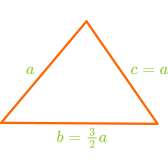
A triangle with two equal sides or two equal angles.

Jump to heading 18.Focus 8

Triangle identification

  • The main approach is to use the conditions involving the relationships between the interior angles and the three sides of a triangle, combined with the properties of triangles to determine the shape of the triangle.
  • Focus should be placed on mastering the characteristics of Equilateral triangles, Isosceles triangles, Right triangles, Isosceles right triangles.
  • When the given conditions in a problem involve the side lengths of a triangle, the key is to use identity transformations to find the relationships among a,b,c.

Jump to heading 20The three sides a,b,c of ABC satisfy 1+bc=b+cb+ca, then the triangle is ?.

(A)An isosceles triangle with side a as the leg(B)An isosceles triangle with side a as the base(C)Equilateral triangle(D)Right triangle(E)Obtuse triangle

Jump to heading Solution

b+cc=b+cb+cab+cc=b+cb+ca=b+ca=cSince condition a+b>c satisfied,the numerator0and equalb=a

Jump to heading Conclusion

  • Derived Solution

    (A)
    According to the Solution, get b=a, so choose A.

  • Formula used

    a+b>cTriangle Inequality theorem

  • Additionally, if the problem is bc1=bcb+ca

    bcc=bcb+cabcc=bcb+ca=bc=0Assume that bc=0bcc=bcb+ca=c=b+caAssume that bc0b=ca=b


Jump to heading 21The three sides of ABC are a,b,c and they satisfy 4a2+4b2+13c28ac12bc=0, then ABC=?.

(A)Right triangle(B)Isosceles triangle(C)Equilateral triangle(D)Isosceles right triangle(E)Acute triangle

Jump to heading Solution

  • Factoring by grouping into a perfect square form, Non-negative (x)20

    4a28ac+4c2+4b212bc+9c2=04(ac)2+(2b3c)2=0a=c2b=3c(x)2=0

Jump to heading Conclusion

  • Derived Solution

    (B)
    According to the Solution, get a=c2b=3c, so choose B.

  • Formula used

    (ab)2=a22ab+b2Perfect square formula


Jump to heading 22The three sides of ABC are a,b,c. If a2+2bc=b2+2ac=c2+2ab=27, then ABC=?.

(A)Isosceles triangle(B)Isosceles right triangle(C)Obtuse triangle(D)Right triangle(E)Equilateral triangle

Jump to heading Solution

{a2+2bc=27b2+2ac=27c2+2ab=27a2+b2+c2+2ab+2ac+2bc=27×3Add all terms together to form a perfect square(a+b+c)2=81a+b+c=81=9(a2+2bc)(b2+2ac)=2727a2b2+2bc2ac=0(a+b)(ab)+2c(ba)=0(ab)(a+b2c)=0a=ba+b=2c(0)(a+b2c)=0(ab)(0)=0a=b{a+b+c=9c+2a=9a2+2ac=27c2+2a2=27(c2+2a2)(a2+2ac)=2727c22ac+a2=0(ca)2=0c=a(0)2=0c+2c=9a=c3c=9c=93=3a=b=c=3a+b=2c{a+b+c=92c+c=93c=9c=93=3a+b=6b2+6a=27c=39+2ab=27c=3ab=182=9629a+b2ab6=6a=ba+b=6a=b=3a=b=c=3

Jump to heading Conclusion

  • Derived Solution

    (E)
    According to the Solution, get a=b=c=3, so choose E.

  • Formula used

    {(a+b)2=a2+2ab+b2(ab)2=a22ab+b2Perfect square formulaa2b2=(ab)(a+b)Difference of squares formulaa+b2abArithmetic Mean-Geometric Mean Inequality


Jump to heading 19.Congruence of Triangle

Jump to heading 1Definition

If two triangles have the same shape and size, they're said to be congruent.

Jump to heading 2Identification

Congruence can be identified using side-side-side (SSS), side-angle-side (SAS), angle-side-angle (ASA), angle-angle-side (AAS).

Jump to heading 3Properties

If two triangles are congruent, their corresponding sides, corresponding angles, and areas are equal. In mathematics terms, the two triangles are equivalent, having the same side lengths, angles, and areas.

Jump to heading 4Applications

When folding, symmetry, or rotation occurs, congruence analysis can be used.

Jump to heading 20.Similarity of Triangle

Jump to heading 1Definition

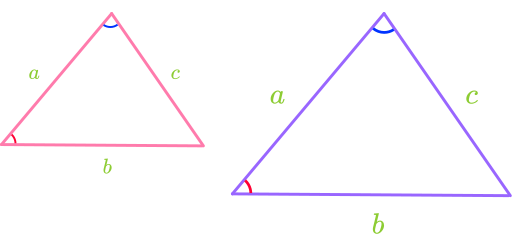
If two triangles have the same shape and their sizes are proportional, they're said to be similar.

  • Proportionality of 1 implies congruence.

Jump to heading 2Identification

Similarity can be identified by two pairs of corresponding interior angles being equal.
Jump to heading 3Properties

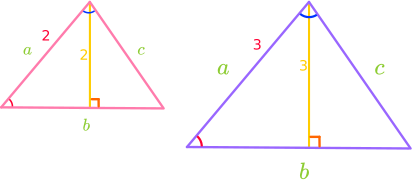
  1. Jump to heading In similar triangles, the ratios of corresponding sides are equal.
    • Known as the similarity ratio: a1a2=b1b2=c1c2=k.
  2. In similar triangles, the ratio of the altitudes, medians, and angle bisectors are also equal to the similarity ratio.
  3. In similar triangles, the ratio of the perimeters is equal to the similarity ratio.
    • C1C2=k.
  4. In similar triangles, the ratio of the area is equal to the square of the similarity ratio.
    • S1S2=k2.

Jump to heading 4Applications

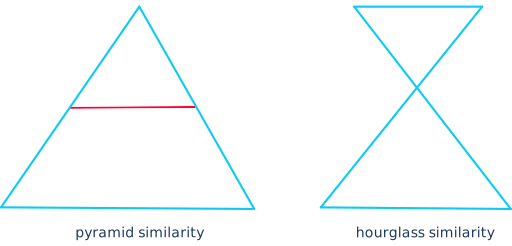
  • When parallel lines appear, similarity should be used for analysis.

    Remark: The properties of similar triangles can be fully extended to other similar figures, such as quadrilaterals.
Jump to heading 21.Focus 9

Triangle congruence

  • When folding, symmetry, or reflection is involved, congruent analysis should be used.

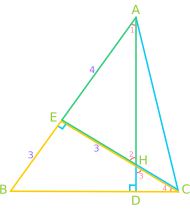
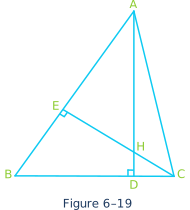
Jump to heading 23Figure 6–19, in triangle ABC, ADBC at point D, CEAB at point E, AD and CE intersect at point H, if EH=EB=3,AE=4, then CH=?.
(A)1(B)43(C)53(D)3(E)2

Jump to heading Solution

  • Find the equal side and the equal angle (Acute angle) in two congruent right triangles

    Equal angle (Acute angle){1+2=903+4=902=3Vertical angles are equal1=4Equal side{EH=EBAEHCEBAE=CE=4CH=CEEH=43=1

Jump to heading Conclusion

  • Derived Solution

    (A)
    According to the Solution, get CH=CEEH=1, so choose A.

  • Formula used

    Right triangle congruence{Find a side and an angle (Acute angle)Find their two sides(No needto find the third side because the Pythagorean theorem is satisfied)


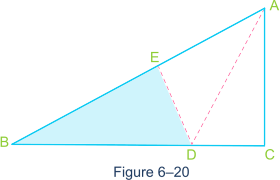
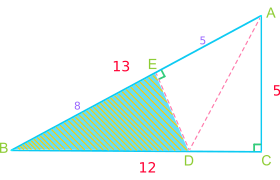
Jump to heading 24Figure 6–20, in a right triangle ABC, the hypotenuse AB=13 and the leg AC=5, the leg AC is folded onto the hypotenuse AB so that it coincides with the hypotenuse, and point C coincides with point E, the fold is AD, what is the area of the shaded region in the figure ?.

(A)20(B)403(C)383(D)14(E)12

Jump to heading Solution

  • Show known conditions

    BC=125,12,13ACDAEDAE=AC=5BE=135=8

  • 1Solve for the ED length of the shadow

    BDEBACDEAC=BEBCDE5=812DE×12=8×5DE×12=40DE=4012=103SBDE=12×103×8=806=403

  • 2Solve using the area ratio equal to the similarity ratio squared

    SBDESBAC=(812)2=(23)2=49SBAC=12×5×12=30SBDE30=49SBDE×9=30×4SBDE×9=120SBDE=1209=403

Jump to heading Conclusion

  • Derived Solution

    (B)
    According to the Solution, get SBDE=403, so choose B.

  • Formula used

    (5,12,13)Commonly used pythagorean numbersa1a2=b1b2=c1c2=kSimilar triangle propertiesS1S2=k2Similar triangle propertiesS=12ahTriangle area formula


Jump to heading 22.Focus 10

Triangle similarity

  • When parallelism occurs, similarity analysis is used. For the similar figure, the area ratio is equal to the square of a similarity ratio.
  • Congruent shapes look at the sides.
  • Similar shapes look at angles.

Jump to heading 25There are ? correct options below.

(1)All right triangles are similar(2)All isosceles triangles are similar(3)All parallelograms are similar(4)All equilateral triangles are similar(5)All trapezoids are similar(6)All squares are similar(7)All rectangles are similar(8)All circles are similar(A)1(B)2(C)3(D)4(E)5

Jump to heading Solution

(1)All right triangles are similar306090454590Two pairs of corresponding interior angles are not equal(2)All isosceles triangles are similarTwo pairs of corresponding interior angles are not equal(3)All parallelograms are similarFour pairs of corresponding interior angles are not equal(4)All equilateral triangles are similar606060=606060Two pairs of corresponding interior angles are equal(5)All trapezoids are similarThe corresponding interior angles are not equal and the corresponding sides are not proportional(6)All squares are similarFour pairs of corresponding interior angles 90 are equal(7)All rectangles are similarThe corresponding sides are not proportional(8)All circles are similarThe circles are similar because they have the same shape, just different sizes

Jump to heading Conclusion

  • Derived Solution

    (C)
    According to the Solution, get (4),(6),(8), so choose C.

  • Formula used

    Similar triangle identificationa1a2=b1b2=c1c2=kSimilar triangle properties


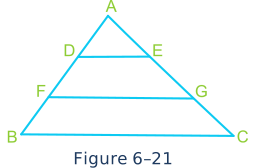
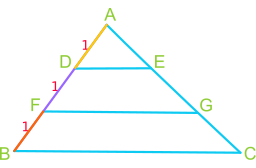
Jump to heading 26Figure 6–21, in ABC,DE,FG,BC are parallel to each other, AD=DF=FB, then SADE:SquadrilateralDEGF:SquadrilateralFGCB=?.

(A)1:3:5(B)1:2:5(C)1:3:4(D)1:3:6(E)2:3:5

Jump to heading Solution

  • Show known conditions

    ADEAFGABCSADE:SAFG:SABC=AD2:AF2:AB2SADE:SAFG:SABC=12:22:32=1:4:9SADE:SquadrilateralDEGF:SquadrilateralFGCB=1:(41):(94)SADE:SquadrilateralDEGF:SquadrilateralFGCB=1:3:5

Jump to heading Conclusion

  • Derived Solution

    (A)
    According to the Solution, get SADE:SquadrilateralDEGF:SquadrilateralFGCB=1:3:5, so choose A.

  • Formula used

    Similar triangle definitionS1S2=k2Similar triangle properties


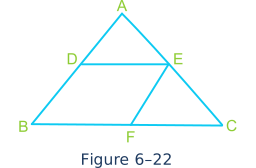
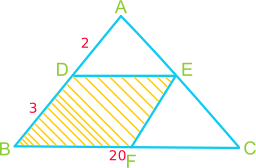
Jump to heading 27Figure 6–22, in ABC,D,E,F are points on AB,AC,BC respectively, and DEBC,EFAB,AD:DB=2:3,BC=20, then CF=?.

(A)15(B)403(C)383(D)14(E)12

Jump to heading Solution

  • Show known conditions

    DEFB is a parallelogramADEABCDEBC=ADABDE20=25DE×5=2×20DE×5=40DE=405=8BF=DE=8CF=BCBF=208=12

Jump to heading Conclusion

  • Derived Solution

    (E)
    According to the Solution, get CF=12, so choose E.

  • Formula used

    a1a2=b1b2=c1c2=kSimilar triangle propertiesSimilar triangle applications


PlatformsCoursesCoursewares
YouTubeWatchCourseware
DailymotionWatch
RumbleWatch